
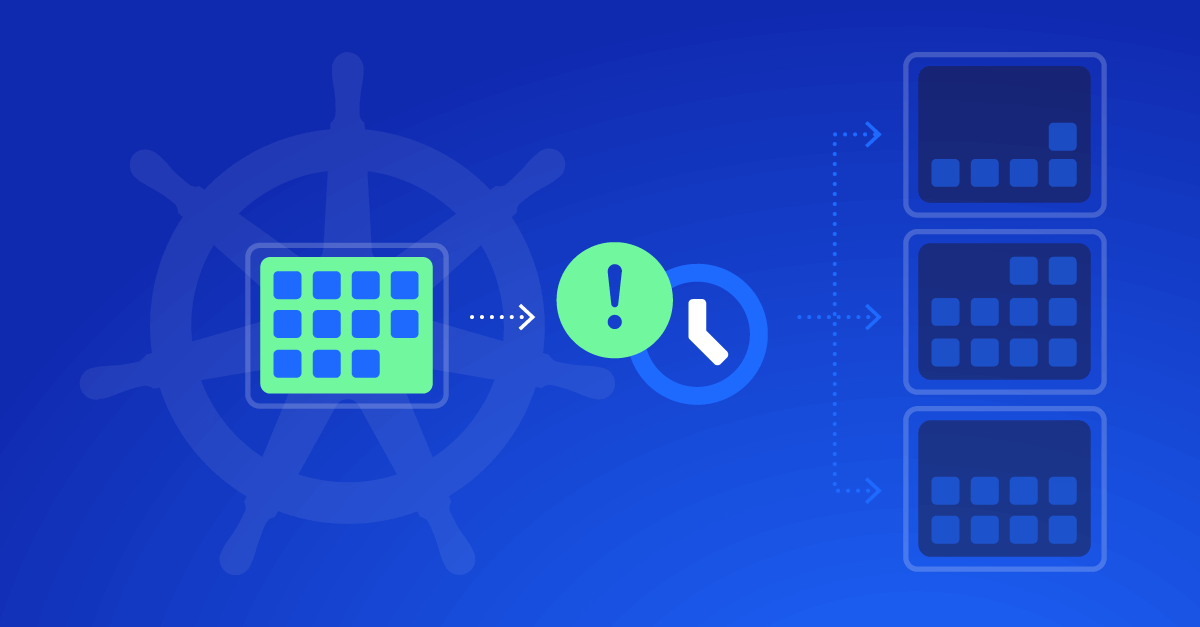
Kubernetes was built for elasticity.
With modern autoscaling tools like Karpenter and Cluster Autoscaler, clusters can spin up new nodes in seconds to handle traffic spikes.
But in many environments, scaling still feels slower than expected.
The reason is often the same:
Stateful workloads.
Databases, message brokers, and search engines frequently become the largest bottleneck in cluster scaling, introducing delays that slow down the entire environment. While stateless workloads scale instantly, stateful workloads introduce storage dependencies, scheduling constraints, and orchestration delays that reduce overall elasticity.
For organizations running large Kubernetes clusters, understanding this difference is critical for improving both performance and cost efficiency.
Stateless workloads scale instantly
Stateless applications are ideal for Kubernetes scaling.
When demand increases:
- New pods are created
- The scheduler places them on available nodes
- Containers start running
There are no external dependencies preventing the pod from starting.
This means scaling events can happen within seconds.
This model works perfectly for services like:
- APIs
- web applications
- microservices
- stateless processing workers
These workloads respond quickly to autoscaling signals and maximize cluster efficiency.
Stateless vs Stateful scaling
The difference between stateless and stateful workloads becomes clear during scaling events.
Stateless workloads can start almost immediately after scheduling. Stateful workloads must wait for storage operations and additional orchestration steps before they become active.

Stateless pods start immediately after scheduling, while stateful pods must wait for storage attachment and mounting before they can run.
Stateful workloads introduce friction
Stateful workloads operate differently.
Applications like databases, Kafka, or Elasticsearch require persistent storage and stable identities. Kubernetes manages these workloads using StatefulSets and Persistent Volumes, which introduce additional orchestration steps.
Before a stateful pod can start, Kubernetes must ensure:
- the correct volume is available
- the storage is attached to the node
- topology constraints are satisfied
- the workload identity remains consistent
Each of these steps adds latency to the scheduling process.
The hidden scaling delay: volume attachments
In most cloud environments, persistent storage is backed by block storage systems such as AWS EBS.
When Kubernetes schedules a stateful pod, the system must:
- Identify the required volume
- Detach it from the previous node (if necessary)
- Attach it to the new node
- Mount it inside the container runtime
This process typically takes 10–60 seconds per pod.
During scaling events involving multiple pods, these delays accumulate and slow down the entire scaling process.
Meanwhile, autoscalers may already have provisioned new nodes, leaving them temporarily underutilized while storage operations complete.
Scheduling constraints add even more complexity
Stateful workloads often come with strict placement requirements.
For example:
- Persistent volumes are availability zone specific
- workloads may enforce pod anti-affinity
- storage classes may enforce topology constraints
If a pod is scheduled on the wrong node, Kubernetes must retry the scheduling process.
This creates additional scheduling friction, which delays scaling and reduces cluster efficiency.
Stateless workloads rarely face these constraints.
The cost impact of stateful scaling delays
The performance implications are obvious, but there is also a significant cost impact.
When scaling slows down due to stateful workloads:
- autoscalers may provision extra nodes unnecessarily
- compute resources remain underutilized while waiting for storage
- clusters temporarily run more capacity than required
Over time, these inefficiencies increase infrastructure costs and reduce the effectiveness of autoscaling strategies.
For organizations running large Kubernetes environments, this can translate into significant unnecessary compute spend.
Designing clusters for better elasticity
The key to improving cluster elasticity is not eliminating stateful workloads—it’s minimizing their impact on scaling.
Several architectural practices help achieve this.
Separate Stateful and Stateless workloads
Running stateful services on dedicated node pools prevents them from interfering with the scaling behavior of stateless applications.
This improves scheduling efficiency and creates clearer autoscaling signals.
Align storage and scheduling
Topology-aware storage configurations can significantly reduce scheduling delays.
Using storage classes such as WaitForFirstConsumer ensures volumes are provisioned in the correct availability zone, avoiding unnecessary scheduling retries.
Reduce storage churn
Frequent pod restarts trigger repeated volume attachment operations.
Keeping stateful workloads stable reduces storage churn and improves scheduling speed.
Let stateless workloads drive scaling
Stateless services typically represent the elastic layer of modern applications.
Allowing them to drive autoscaling signals helps clusters respond faster to real traffic demand.
Elastic clusters require a different approach to state
Kubernetes was designed to scale compute quickly, but persistent state introduces unavoidable complexity.
Clusters that treat all workloads the same often experience slower scaling, higher costs, and reduced efficiency.
The most efficient environments recognize the difference:
Stateless workloads provide elasticity.
Stateful workloads provide persistence.
Designing clusters around this distinction allows organizations to achieve both high performance and cost-efficient scaling.
If you want to improve scaling time and take the load off your engineers, click here.