
Kubernetes infrastructure teams compromise on cost savings all the time. That’s just a fact of the trade. Ensuring performance and availability in their apps is a lot more important than saving a few dollars per hour per workload. But those few bucks then aggregate. Our research shows that 34% of compute usage still goes uncovered and is paid for at on-demand rates. That’s a lot of missed savings opportunities.
CSPs do offer discounts, but these discounts are commitment-based, depending on customers predicting their compute needs for the next one to three years. Anyone who manages Kubernetes environments knows how unrealistic that is.
This tension leads many teams to overprovision just to feel safe. Those idle/uncovered workloads become costly waste. On top of that, teams must manually monitor commitments and make judgment calls about renewals. It takes ongoing time and attention from teams who already have too much on their plates.
This is the environment that shaped Daily Micro-Savings Plans.
Committing, but flexibly
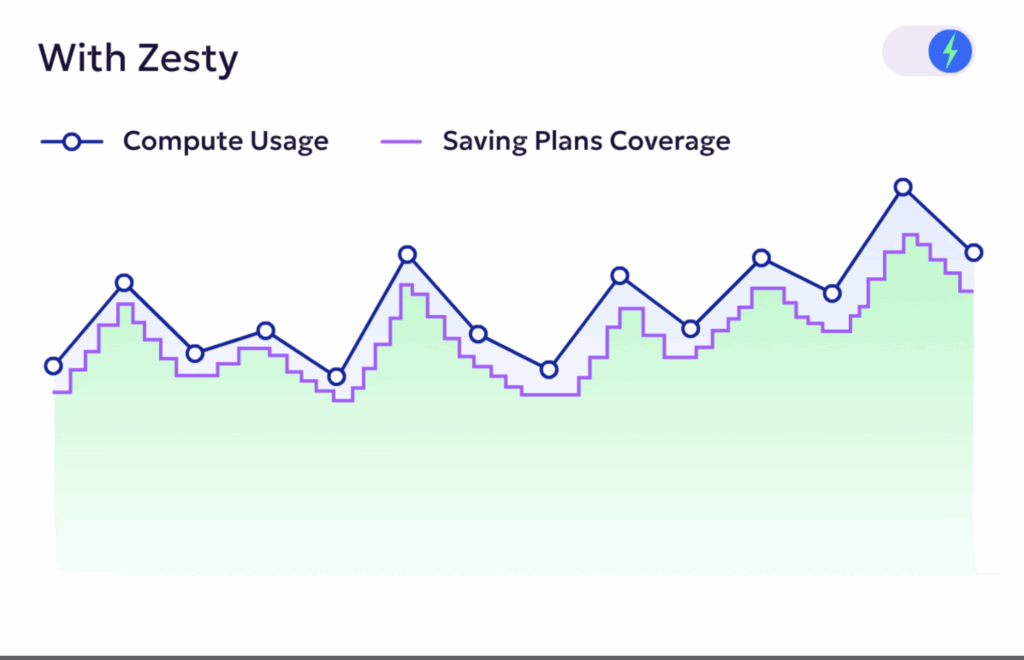
Zesty’s Commitment Manager approaches commitments with a different mindset. Instead of asking teams to lock in large commitments for long periods, the system purchases small commitment blocks every 24 hours. Renewal decisions happen daily, based on what workloads actually did, rather than what teams hoped they would do months or years earlier. The result is a commitment strategy that evolves with real usage and stays continuously aligned with the state of the environment.
Coverage stays high and stable. Long-term exposure drops significantly. The pressure to get long-range predictions right disappears.
You can finally adapt your commitments in real time
Commitment Manager begins with the core data that any good cost model needs: past usage patterns, expected growth, and short-term fluctuations. Then, it applies optimization policies defined by the users. These policies may include growth expectations, preferred coverage targets such as 80 or 90%, and the mix between 1-year and 3-year terms. That mix lets teams balance higher savings from longer commitments with flexibility from shorter ones, depending on their comfort with risk.
Once preferences are set, automation takes over. The system continually aligns commitments to what is happening in the environment. When workloads increase, coverage increases. When workloads contract, commitments reduce accordingly. This alignment is not a quarterly or monthly recalculation. It is a daily process.
Daily Micro-SPs make this possible. Each day, the system buys new micro-sized commitments before existing ones expire. This avoids gaps in coverage and ensures the commitment portfolio stays fresh. Over time, the combination of daily adjustments and a blended set of 1-year and 3-year terms produces a powerful effect. Teams receive the flexibility of daily tuning together with the long-term discounts available from traditional commitments. Coverage stays consistently high, and savings reach their full potential.

How daily commitments change the way you manage infrastructure
For DevOps and FinOps teams, the impact is easy to see.
Flexibility becomes built in. Commitments move in sync with real workloads, not old predictions.
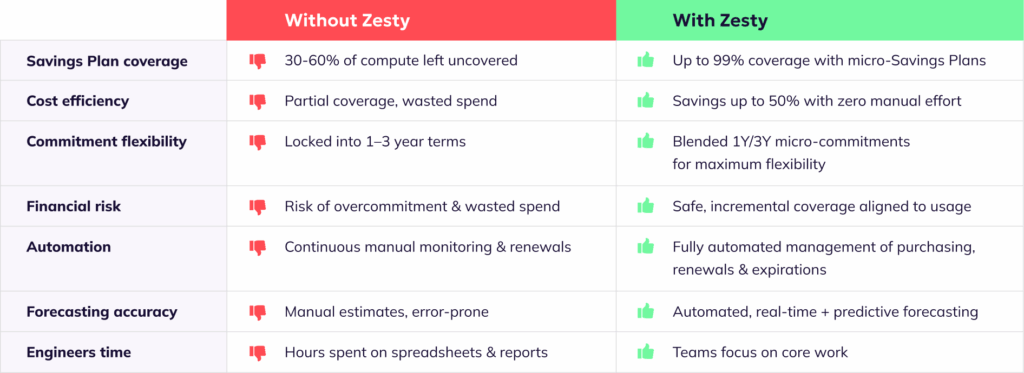
Savings improve without added risk. Users can reach savings of up to 50% compared to on-demand pricing, without the waste caused by overcommitting.
Automation handles the heavy lifting. Manual monitoring and recalculations disappear. Adjustments happen automatically and continuously.
Applications that experience fluctuating demand is a good example. Product launches, holiday traffic, and surprise AI-driven workloads all create irregular patterns. Under a traditional commitment model, these swings often lead to overprovisioning and wasted spend or unexpected on-demand bills. With Daily Micro-SPs, coverage rises and falls as needed. The team stays protected and efficient at the same time.
The future looks flexible
Daily Micro-Savings Plans introduce a more adaptive way to manage commitments. Instead of forcing teams to choose between savings and flexibility, they offer a model that delivers both.
If reducing cloud spend while maintaining agility is a priority, this is a good time to explore Zesty’s Commitment Manager. You can learn more about how Daily Micro-Savings Plans support stronger performance, higher efficiency, and a more predictable cloud cost strategy.
If you want to learn more about how micro-Savings Plans work and how they can reduce your cloud costs, click here.