- Average CPU utilization in production Kubernetes clusters sits below 15%, with memory overprovisioning above 70% in most vendor benchmark reports.
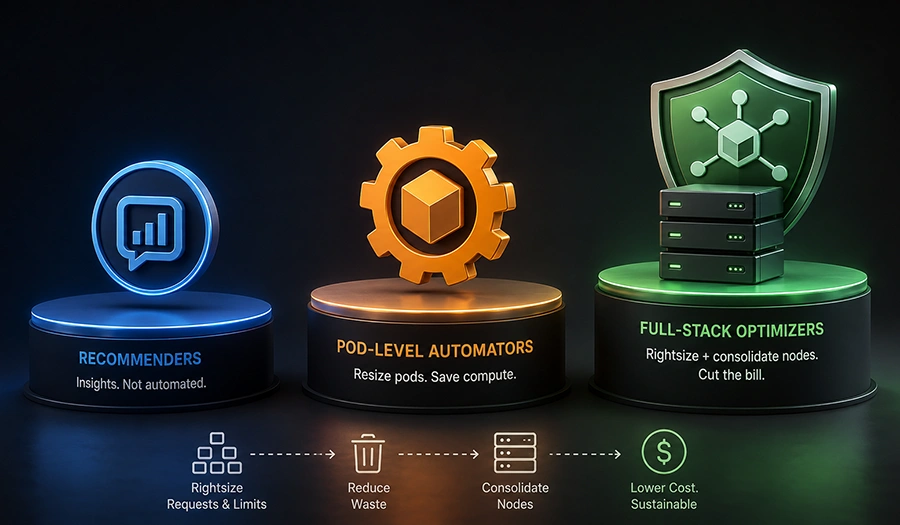
- Pod rightsizing tools split into three tiers: recommenders, pod-level automators, and full-stack optimizers that also consolidate nodes.
- Cutting resource requests without shrinking the node footprint produces reclaimed headroom, not a lower invoice.
- In-place pod resizing removes the restart penalty for CPU changes, but memory resize still depends on the node’s cgroup version.
- Teams above 50 workloads cannot keep manual recommendations current; drift outpaces review cycles within weeks.
- Zesty combines Multi-Dimensional Autoscaling (MDA) for continuous pod rightsizing and min replica optimization, with Adaptive Pod Placement (APP), cutting Kubernetes costs by 50-80%.
Introduction
Pod rightsizing tools exist because production Kubernetes clusters run wildly overprovisioned. Vendor benchmark reports covering tens of thousands of clusters consistently put average CPU utilization against provisioned Kubernetes resource requests in the single digits to low teens, with memory overprovisioning above 70% in a typical fleet. Dozens of pod rightsizing tools have shown up to close that gap. Most teams pick one, apply its recommendations, and see a smaller change on the cloud invoice than they expected. The reason is simple: requests came down, but node count did not move.
This article organizes the market into three tiers based on how far each tool closes that loop, from recommendation-only tools like Goldilocks up to full-stack platforms like Zesty that rightsize pods, optimize min replicas, and adapt pod placement in the same workflow. You’ll get a map of the market, eight tools compared side by side, and a weighted scorecard you can run against your own cluster before you commit to any of them.
What Pod Rightsizing Tools Actually Fix (and What They Don’t)
Pod rightsizing means aligning CPU and memory resource requests and limits with what a container actually consumes, rather than what an engineer guessed at during deployment. Done correctly, it fixes two distinct failure modes at once: overprovisioning, where teams pay for headroom nobody uses, and underprovisioning, where requests set too low cause CPU throttling and Out of Memory (OOM) kills. Most rightsizing tools, including Kubernetes’ own Vertical Pod Autoscaler (VPA), focus on solving both by watching real usage and proposing or applying new values.
Here’s where the gap opens up. Say a 200-node cluster runs a rightsizing pass and drops total requested CPU by 40%. On paper, that should translate directly into fewer nodes and a smaller bill. In most clusters, it doesn’t, because pods stay exactly where they were scheduled. The Cluster Autoscaler only removes a node when every pod on it can be evicted and rescheduled elsewhere, and nothing in a standard rightsizing workflow triggers that eviction. The result: utilization on each node ticks down, the node count stays at 200, and the invoice barely moves. This gap between accurate requests and an actual invoice reduction is worth understanding in more depth, see our Pod Rightsizing: Why It Fails to Reduce Kubernetes Costs.
Converting reclaimed capacity into an actual invoice reduction requires three things working together: rescheduling pods onto fewer nodes through active bin-packing, scaling down the nodes that eviction frees up, and picking the right instance shape for the new, denser workload profile. Tools that stop at the first step (changing requests) leave the second and third steps to chance, or to whatever the Cluster Autoscaler happens to do on its own schedule.
Zesty’s Multi-Dimensional Autoscaling (MDA) treats this as one connected problem instead of two separate ones. Continuous pod rightsizing feeds directly into Zesty’s Adaptive Pod Placement (APP), so reclaimed capacity gets converted into removed nodes automatically rather than sitting unused on a cluster that never shrinks.
The Three Tiers of Pod Rightsizing Tools
Most comparisons split this market into two buckets: tools that recommend, and tools that automate. That framing hides the piece that actually determines whether your bill changes. A cleaner map uses three tiers.
Tier 1: Recommenders
These tools analyze historical usage and surface suggested request and limit values, then stop. A human reviews and applies each change. This gives full control but zero throughput: recommendations go stale within weeks as workloads shift, and review cycles rarely keep pace once a cluster grows past roughly 30-50 workloads.
Use this tier when: you run a small number of workloads, have change-management requirements that mandate human review, or are still building trust in automated changes.
Tier 2: Pod-level automators
These apply request and limit changes continuously, without a human approving each one. This solves the drift problem that kills Tier 1 tools at scale. What it doesn’t solve is the node footprint: the Cluster Autoscaler is left to decide, on its own timeline, whether freed capacity turns into fewer nodes. A key sub-distinction inside this tier is how changes get applied: eviction-based tools restart the pod to apply a new value, while newer approaches use in-place resize to avoid the restart.
Use this tier when: drift is your main problem and you’re comfortable managing node-level savings separately, or manually.
Tier 3: Full-stack optimizers
These rightsize pods continuously, then actively reschedule and consolidate workloads so node count follows the reduced requests instead of drifting independently. This is the only tier where a drop in requested resources reliably maps to a drop in the invoice. Zesty is the clearest example: MDA handles continuous pod rightsizing min replicas, while APP handles pod placement to improve node consolidation on the same loop.
Use this tier when: you want request reductions to actually show up as a lower bill, without a second manual workflow to manage node count.
| Tier | What changes | What your bill does |
|---|---|---|
| Tier 1: Recommenders | Suggested values only, applied manually | Unchanged until someone acts, then drifts back |
| Tier 2: Pod-level automators | Requests/limits applied continuously | Improves slightly; node count mostly unaffected |
| Tier 3: Full-stack (Zesty) | Resource requests, pod placement, and minReplica all move together | Drops in proportion to reclaimed capacity |
Kubernetes Rightsizing Tools Compared
The table below covers eight Kubernetes rightsizing tools spanning all three tiers. Zesty sits in the first row because it’s the only entry where horizontal and vertical optimization run as a single automated workflow.
| Tool | Tier | Applies changes automatically | Min replica optimization & Pod placementincluded | HPA-safe | Dependencies | Best for |
|---|---|---|---|---|---|---|
| Zesty | 3 | Yes | Yes | Yes | None (no Prometheus/VPA required) | Teams wanting bill impact, not just requests changed |
| Kubernetes VPA | 1/2 | Optional (Auto mode) | No | Partial | Metrics Server | Teams comfortable managing VPA objects directly |
| Goldilocks | 1 | No | No | Yes | VPA | Small clusters wanting a dashboard view of recommendations |
| KRR (Kubernetes Resource Recommender) | 1 | No | No | Yes | Prometheus | Teams already running Prometheus who want a fast CLI check |
| Kubecost | 1 | No | No | Yes | Prometheus | Teams wanting cost allocation plus rightsizing hints |
| CloudZero | 1 | No | No | Yes | Cloud billing export | FinOps teams prioritizing cost intelligence over automation |
| Hyperglance | 1 | No | No | Yes | Cloud account access | Teams wanting visual, cross-cloud resource mapping |
| Finout | 1 | No | No | Yes | Cloud billing export | Multi-cloud FinOps reporting with rightsizing suggestions |
Zesty [Zesty’s Multi-Dimensional Autoscaling (MDA)]: a full-stack Kubernetes optimizer that continuously rightsizes pods, optimizes min replicas, then places and consolidates those workloads onto fewer nodes through Adaptive Pod Placement (APP) in the same automated loop. It requires no Prometheus or VPA deployment, performs its own horizontal scaling decisions coordinated with vertical rightsizing as one system, rather than running as a second controller alongside HPA, runs across EKS and AKS, and reports 50-80% Kubernetes cost reduction across customer deployments. The hard limit for any full-stack platform is the same as for any managed service: teams that want every scaling decision made manually should look at Tier 1 instead.
Kubernetes VPA: the upstream project most rightsizing tools build on or compare themselves against, making it the reference point for VPA alternatives. VPA watches usage and can recommend or, in Auto mode, apply new requests. It does what it says on the label well, but has no concept of node consolidation, and Auto mode evicts pods to apply changes, which complicates use alongside HPA on the same metric.
Goldilocks: a lightweight dashboard built on top of VPA that visualizes recommended requests across namespaces. It does one thing clearly and does not automate anything. Best suited to small teams that want a quick, low-commitment view before deciding whether to automate at all.
KRR (Kubernetes Resource Recommender): an open-source, Prometheus-based CLI tool that generates rightsizing recommendations without deploying any in-cluster agent. It’s fast to run and easy to audit, but recommendation-only, so it inherits every limitation of Tier 1 at scale.
Kubecost: primarily a cost allocation and visibility platform that layers rightsizing recommendations on top of its cost data. Strong for teams that need cost breakdowns by namespace or team alongside sizing guidance, but it does not apply changes or touch node count itself.
CloudZero: a cost intelligence platform aimed at engineering and finance alignment, with rightsizing insights derived from billing and usage data. Useful for spend visibility across a broader cloud footprint, but rightsizing is a reporting feature rather than an automated action.
Hyperglance: a visualization-first tool that maps cloud resources and flags rightsizing opportunities across accounts. Good for teams that want a visual inventory before acting, though everything still requires manual follow-through.
Finout: a FinOps cost management platform with rightsizing suggestions built into broader multi-cloud reporting. Strongest where the priority is unified spend visibility rather than automated pod or node changes.
Across this list, Zesty is the only entry where pod rightsizing and node reduction are the same automated workflow rather than two separate tasks handed to two different tools. See how Zesty closes the loop.
The Pod Rightsizing Tool Scorecard
Run this scorecard against your own cluster before choosing a tier. Six criteria, weighted to sum to 100, each scored 1-5.
| Criterion | Weight | 1-5 scoring rubric |
|---|---|---|
| Workload count and drift rate | 25 | 1 = under 20 workloads, stable; 5 = 50+ workloads, frequent redeploys |
| Node-level savings capture | 20 | 1 = tool touches requests only; 5 = tool actively reduces node count |
| HPA and stateful compatibility | 20 | 1 = no HPA/stateful workloads; 5 = heavy HPA use, long-running or stateful services present |
| Application method | 15 | 1 = manual review acceptable; 5 = restarts are unacceptable, in-place required |
| Dependencies and setup cost | 10 | 1 = happy to run Prometheus/VPA; 5 = want zero new infrastructure |
| Total cost of ownership (TCO) | 10 | 1 = engineering time is free; 5 = engineering hours cost more than a subscription |
Profile 1 — 20-workload startup, strict change management: low drift, small footprint, human review still feasible. Scores land the team solidly in Tier 1; a recommender like Goldilocks or KRR is enough for now.
Profile 2 — 200-workload platform team running HPA: high drift rate, heavy HPA usage, and node-level savings become material at this scale. This profile scores into Tier 3.
Profile 3 — multi-cluster enterprise with stateful services: high workload count, low eviction tolerance for stateful services, and dependency overhead matters across many clusters. This also scores into Tier 3.
Zesty fits both of the Tier 3 profiles above: Multi-Dimensional Autoscaling (MDA) performs replica-count optimization directly, so these profiles don’t need a separately configured Horizontal Pod Autoscaler (HPA) making conflicting decisions on the same workloads, and Adaptive Pod Placement (APP) avoids forcing eviction on services that can’t tolerate a restart, while still improving node consolidation across every cluster in the estate.
The Reliability Questions Vendors Don’t Volunteer
Ask any vendor these five questions before you sign anything.
- How do you apply a change, eviction or in-place resize? What you want to hear: in-place resize wherever the cluster supports it. Why it matters: in-place pod resizing removes the restart requirement for CPU changes, but memory resize behavior still depends on the node’s cgroup version. Nodes running cgroup v1, still common on many managed clusters, require a restart regardless of the pod’s resize policy. For the full mechanics of in-place resize and how to roll it out safely, see our Kubernetes Pod Rightsizing guide. Verify the current Kubernetes version and feature gate status against upstream documentation before treating any version-specific claim as settled, and phrase it conservatively if you can’t confirm it.
- What happens when HPA and vertical scaling both target CPU? What you want to hear: the tool scopes vertical scaling to memory, moves HPA to custom metrics, or actively coordinates both. Why it matters: two controllers independently adjusting CPU on the same pod produce conflicting signals and unstable scaling behavior. This is one of several specific ways autoscaling layers can work against each other, see the fuller breakdown in our EKS Cost Optimization: Compute Savings Stack, Ranked by ROI.
Zesty’s Multi-Dimensional Autoscaling (MDA) rightsizes pods and optimizes minreplicas itself, as one coordinated decision, rather than running two separate controllers that could compete over the same signal.zes pods, optimizes minreplicas, and coordinates with HPA instead of running as a second, competing controller.
- Do you respect PodDisruptionBudget intent under concurrent changes? What you want to hear: yes, with details on how. Why it matters: individually valid eviction requests can collectively breach a PodDisruptionBudget (PDB)‘s maxUnavailable setting when several changes land at once.
- What happens to stateful workloads that cannot be evicted? What you want to hear: placement changes that avoid disruptive eviction entirely for workloads that can’t tolerate a restart. Why it matters: a tool that only knows how to evict will either skip stateful workloads or disrupt them. Zesty handles stateful workloads through placement changes that route around eviction rather than forcing it.
- How do you handle seasonal traffic, weekly and monthly peaks or just the last few days? What you want to hear: an observation window long enough to include weekly and monthly peaks. Why it matters: a short observation window rightsizes a cluster for last Tuesday, not for the traffic pattern that actually matters.
A 14-Day Evaluation Plan
Days 1-3: capture the baseline. Record usage against requests, OOM events, CPU throttling ratio, and, critically, current node count and cost. These last two numbers are what most teams forget to record, and they’re the only numbers that prove whether savings were real once the tool is running.
Days 4-7: observe. Run the tool in observation or recommendation mode against a full two-week metrics window so weekly peaks get captured, not just a quiet stretch.
Days 8-11: apply to one low-risk namespace. Confirm throttling and latency haven’t regressed before expanding scope.
Days 12-14: measure the delta. Compare OOM kills, resource utilization, node count, and spend against the Day 1-3 baseline, then gate for wider rollout.
Rollback note: record prior resource values before applying any change, and commit them to version control so the next Continuous Integration/Continuous Deployment (CI/CD) run doesn’t silently reapply old values on top of new ones.
For a Tier 3 evaluation, this plan compresses considerably. Evaluating Zesty mostly means confirming that its policies match your risk tolerance, since MDA and APP already run the baseline, rightsizing, and consolidation loop on their own; the real evaluation work happens on Day 14, reading the node count and spend delta.
Conclusion: Choosing Based on Outcome, Not Feature Count
The tier framework comes down to three sentences. Tier 1 recommenders give full control but require a human to keep pace with drift. Tier 2 automators solve drift but leave node count to chance. Tier 3 optimizers are the only tier where a drop in requests reliably becomes a drop in the invoice.
Under 50 workloads with real review capacity, Tier 1 is enough. Above that, or with HPA, stateful services, or a multi-cluster estate in play, Tier 1 and Tier 2 leave money on the table, because the node footprint never actually moves. That’s the case for Zesty: Zesty rightsizes pods, optimizes minReplicas continuously, and consolidates nodes automatically, with both decisions coordinated as one system rather than run as two independently-tuned controllers, and delivering 50-80% Kubernetes cost reduction without turning into a recurring manual workflow.
Zesty in one paragraph: Zesty’s Multi Dimensional Autoscaling (MDA) continuously rightsizes pod and container requests, optimizes min replicas, then Zesty’s Adaptive Pod Placement (APP) places and consolidates those workloads onto fewer nodes automatically, closing the gap between a smaller resource request and a smaller invoice, across EKS and AKS.
The utilization number sitting in your dashboard right now isn’t a fixed property of your cluster. It’s a measurement taken before optimization ran. Pod rightsizing tools exist to change that measurement; only a Tier 3 tool changes what it costs you.
FAQs
What are pod rightsizing tools, and how do they work?
Pod rightsizing tools analyze real CPU and memory usage against a container’s configured requests and limits, then either recommend or apply new values so the container is provisioned closer to what it actually consumes. Most work by watching metrics over a rolling window and calculating a target that avoids both wasted headroom and throttling risk. Some stop at a recommendation; others apply changes continuously without manual review.
What is the difference between recommendation-only and automated pod rightsizing?
Recommendation-only tools, like Goldilocks or KRR, surface suggested values and leave a human to apply them, which works until workload count or change frequency outpaces review capacity. Automated tools apply changes continuously, which solves drift but says nothing about what happens to node count once requests shrink.
Does rightsizing pods actually reduce my cloud bill?
Only if the node footprint shrinks along with the requests. Reducing requests without rescheduling and consolidating pods onto fewer nodes just creates reclaimed headroom the Cluster Autoscaler may or may not act on. The bill drops when rightsizing, placement, and node scale-down happen together, which is the specific gap Tier 3 tools are built to close.
How does Zesty rightsize pods differently from VPA and recommendation-only tools?
Zesty’s Multi-Dimensional Autoscaling (MDA) continuously rightsizes pods without requiring a Prometheus or VPA deployment, optimizes minReplicas, and feeds those changes directly into Adaptive Pod Placement (APP), which reschedules and consolidates workloads onto fewer nodes in the same loop. Recommendation-only tools and standalone VPA deployments stop at the request change and leave node consolidation to a separate, disconnected process.
Can I run pod rightsizing alongside the Horizontal Pod Autoscaler?
Yes, but only carefully if both controllers target the same metric. Running vertical and horizontal scaling on CPU at the same time can produce conflicting signals; the usual fixes are scoping vertical changes to memory only, moving the Horizontal Pod Autoscaler (HPA) to a custom metric, or using a tool that performs both dimensions itself, which is how Zesty’s Multi-Dimensional Autoscaling (MDA) avoids the conflict a separately configured HPA can introduce on the same metric.
What's the actual cost difference between Tier 2 and Tier 3 tools in practice?
Tier 2 tools typically show real improvement in requested-vs-used ratios but leave node count roughly where it was, capping realistic savings in the 10-20% range. Tier 3 tools that also consolidate nodes routinely report 50-80%, since the bill responds to node count, not request accuracy on its own.
Do I need Prometheus running to evaluate any of these tools?
Most Tier 1 recommenders (KRR, Kubecost) and standalone VPA deployments require it. Tools built without that dependency, like Zesty, remove one real piece of setup overhead, worth checking specifically if your cluster doesn’t already run a Prometheus stack for other reasons.