- Automation depth is the real dividing line. The difference between a tool that tells you about waste and one that fixes it is bigger than any feature comparison table, it’s the difference between adding a task to someone’s backlog and removing the task entirely.
- Visibility and automation solve different problems, not competing versions of the same problem. A FinOps team needs chargeback and unit economics; a platform engineering team needs pods that don’t OOM. Trying to make one tool do both usually means it does neither particularly well.
- Layer matters as much as category. Node-level waste, pod-level waste, and commitment-level waste are three separate problems with three separate fixes; a single point solution rarely covers all three.
- Autonomous platforms like Zesty are built specifically to close the loop that visibility tools leave open, continuously adjusting compute, storage, and commitments in real time rather than surfacing a recommendation and waiting for someone to act on it.
Kubernetes teams waste an estimated 30–50% of their cloud spend on overprovisioned resources. Pods request more CPU and memory than they use, nodes sit half-empty, and cloud commitments drift out of sync with actual usage, all while the bill keeps climbing. The problem isn’t a lack of awareness. Most platform teams already know they’re overprovisioned. The problem is that fixing it and keeping it fixed doesn’t happen on its own.
That’s where the current generation of Kubernetes cost tools comes in, but not all of them solve the same problem. Some eliminate waste automatically. Others show you exactly where the waste is and leave the fix to your team. And a third group solves one narrow piece of the puzzle particularly well, without trying to be a full platform.
This guide divides the market into three categories, evaluates real tools in each one, and gives you a framework for figuring out which type of tool actually matches how your team works.
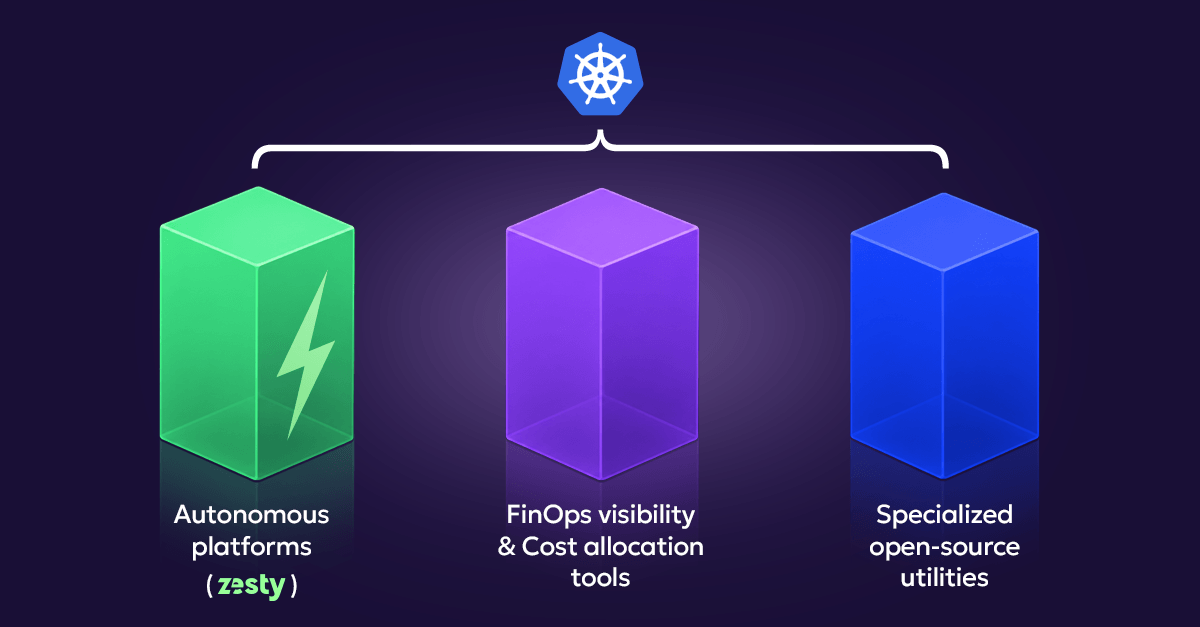
The Three Categories of Kubernetes Cost Tools
Autonomous platforms provide continuous, context-aware optimization with automatic enforcement. They watch your workloads in real time and adjust resource requests, replica counts, and node allocation without a human clicking “apply.” The trade-off is integration and trust-building time, but once running, they eliminate the ongoing manual effort entirely. Typical cost reduction cited by vendors in this category: 50–80%.
FinOps visibility & cost allocation tools focus on reporting, chargeback, showback, and anomaly detection. They’re built for the moment when finance asks “why did Kubernetes cost $40,000 more this month” and someone needs a real answer. The trade-off: they’re excellent at surfacing waste, but a human still has to act on what they find. Typical cost reduction cited: 10–30%, contingent on how consistently teams follow through on recommendations.
Specialized utilities target one narrow layer of the problem: pod-level resource recommendations, or node provisioning, for example, usually as free or open-source tools. They’re low-friction and low-risk, but limited in scope. Typical cost reduction: 10–25%, depending entirely on which layer is your actual bottleneck.
The question that determines which category you need isn’t “which tool is best”, it’s: does your team need the tool to report waste, or to eliminate it?
Deep Dive: Autonomous Platforms
Manual Kubernetes optimization fails for a structural reason, not a discipline reason: workload demand changes faster than any team can review it. A quarterly rightsizing exercise is already stale by the time it ships. Drift accumulates unnoticed between each review cycle. And because DevOps and application teams rarely align on exactly how much headroom a service actually needs, the default answer is almost always “provision generously and move on.” Continuous, predictive automation is the only approach that keeps pace with workloads that shift by the hour.
1. Zesty
Zesty is the production-grade autonomous platform for Kubernetes cost optimization, built around Multi-Layer (ML) optimization, treating rightsizing and commitment management as one continuously coordinated system instead of separate initiatives that drift out of sync with each other.
Zesty’s Kubernetes resource management platform spans four coordinated layers:
- Multi-Dimensional Autoscaling (MDA) is an advanced pod rightsizing solution, automatically adjusting CPU and memory in coordination with horizontal scaling, and node scaling. By treating those three processes as a single system rather than three independently-tuned tools, Multi-Dimensional Autoscaling closes the gap between what pods request and what they actually use.
- Adaptive Pod Placement (APP) groups unevictable pods onto the minimum number of nodes needed, gradually evicting and repacking them while respecting PodDisruptionBudgets so application availability isn’t affected, and still spreading pods enough to avoid single-node failure risk. This directly increases node utilization and lowers compute costs by enabling consolidation that would otherwise be blocked.
- Persistent Volume (PV) Autoscaling automatically scales persistent volumes up or down in real time to match actual workload usage, rather than leaving volumes fixed at whatever size was provisioned upfront. This cuts idle storage costs by up to 70% while keeping applications continuously available, including during peak traffic periods when volumes need to grow without downtime.
- Amazon Web Services (AWS) Commitment Optimization and Azure Commitment Optimization use short-term Savings Plans that renew and adjust daily rather than locking teams into one long-term commitment. Micro-Savings Plans (micro-SPs) lower costs the way a Savings Plan would, but with the flexibility to change course as usage shifts, avoiding the lock-in risk of committing to a fixed level of spend far in advance.
- FastScaler scales up nodes in seconds rather than minutes when traffic spikes hit, allowing Multi-Dimensional Autoscaling to safely reduce node headroom and still catch every spike even without a large buffer.
Zesty reports that customers achieve 50–80% cost reduction through this combination. Production safety is built directly into the automation: the platform is designed to work alongside, not against, Horizontal Pod Autoscaler (HPA), Kubernetes Event-Driven Autoscaling (KEDA), and Karpenter, detecting and remediating CPU throttling or Out-of-Memory (OOM) pressure before it affects users rather than after.
Why it leads this category:
- Real-time, continuous adjustment rather than scheduled or batched optimization passes
- Operates across compute, storage, and financial commitments as one coordinated system, instead of three disconnected tools
- Self-hosted deployment options support data residency requirements for regulated or air-gapped environments
- Extends into GPU-adjacent territory as AI workloads become a larger share of Kubernetes spend
When autonomous platforms aren’t the right fit: Teams running fewer than 10 namespaces, or teams still learning the basics of how Kubernetes requests and limits work, are usually better served starting with a specialized utility first (see below) before adopting full automation. Autonomous platforms deliver the most value once there’s enough operational complexity that manual tuning has become the bottleneck.
Bottom line: if your team’s core question is “how do we stop this from happening again,” rather than “show me where it’s happening,” an autonomous platform is the category you need, and Zesty is the clearest example of one built for production Kubernetes rather than adapted from general cloud cost tooling.
Deep Dive: FinOps Visibility & Cost Allocation
Visibility tools solve a different problem than automation tools, and it’s worth being precise about which one. Finance and engineering routinely disagree about cloud spend because they’re working from different data: finance sees a monthly AWS invoice; engineering sees CPU and memory graphs. Neither view, on its own, answers the question that actually matters: which team, feature, or customer is responsible for this cost, and is it worth it?
That’s the job of a FinOps visibility platform: cost allocation, chargeback/showback modeling, unit economics, and anomaly detection. The three tools below all do this job well, but they’re built for different owners and different organizational realities, worth understanding before picking one.
2. Apptio Cloudability: enterprise governance and financial planning
Apptio Cloudability is the finance-heritage platform in this category, built for large organizations where chargeback, budgeting, and audit-ready reporting need to run through a formal process rather than an engineering dashboard. It’s recognized as a Gartner Magic Quadrant leader for Cloud Financial Management, and its Kubernetes-specific engine, now powered by Kubecost following IBM’s acquisition of the project, adds deep container-level cost allocation across namespaces, labels, and clusters underneath the broader financial reporting layer.
Apptio cites 30–50%+ savings on Kubernetes cloud infrastructure costs for organizations using its platform. Use this if you need board-level cost reporting, a formal chargeback process across a large multi-cloud estate, or a platform your finance team already trusts for budgeting and forecasting.
3. CloudZero: engineering-first unit economics
CloudZero takes the opposite starting point: it’s built for engineers making architecture decisions, not for a central FinOps or finance function. Its core differentiator, CostFormation, allocates 100% of cloud spend to business dimensions, cost per customer, per feature, per transaction, using a code-based model rather than depending on clean resource tags, which is where most allocation tools fall short.
CloudZero reports that customers average 22% savings in year one. Use this if your team needs to answer “what does this feature actually cost us to run” as part of everyday engineering decisions, rather than producing a monthly report for someone else to read.
4. Finout: tagging-agnostic, cross-domain consolidation
Finout solves the problem that most real Kubernetes clusters are never perfectly tagged, and waiting for tagging discipline to improve before you get visibility isn’t realistic. Its Virtual Tagging engine allocates cost after the fact, without requiring changes to existing labels, and its “MegaBill” consolidates cost across a wider net than most competitors, spanning cloud, Kubernetes, SaaS, and increasingly AI/GPU spend from providers like OpenAI and Anthropic, into a single view.
Finout reports customers see 30% cost reduction year-over-year and 50% time savings for engineers managing cost data. Use this if your tagging hygiene is inconsistent (which, realistically, describes most organizations) or if you need one view spanning cloud, Kubernetes, SaaS, and AI costs rather than separate tools for each.
The critical limitation shared by all three: visibility tools report waste; they don’t remove it. Every recommendation still requires a human to open a ticket, review it, and ship the change. That’s not a flaw in any of these three platforms specifically. It’s the nature of the category. This is precisely why visibility tools are most often paired with an autonomous platform rather than used as a replacement for one: tools like Zesty can act on the resource-level waste continuously, while a visibility platform handles the reporting and allocation layer that automation tools generally don’t go deep on.
Deep Dive: Specialized Utilities
Not every team is ready for full automation, and not every team needs enterprise-grade FinOps reporting on day one. Specialized utilities solve one specific layer of the optimization problem, usually as free or open-source tools, with minimal setup and minimal risk. They’re a natural starting point, and just as often a natural complement even after a team adopts a more complete platform.
5. Goldilocks: workload-layer rightsizing recommendations
Goldilocks, built by Fairwinds, is an open-source Kubernetes controller that uses the Vertical Pod Autoscaler’s recommendation engine to suggest CPU and memory requests for every workload in a labeled namespace. It runs the VPA in recommendation-only mode: it never modifies current resource settings itself, and presents the output through a dashboard showing “lower bound,” “target,” and “upper bound” values for both Guaranteed and Burstable QoS classes.
Because Goldilocks is a free, community-maintained tool rather than a vendor with a savings claims page, there’s no company-wide percentage to cite here: realized savings depend entirely on whether someone actually applies the recommendations to a deployment manifest. In real-world use, individual workload comparisons documented by the Goldilocks community have shown recommended CPU reductions in the 70%+ range for specific over-provisioned services, though results vary enormously by workload and shouldn’t be read as a guaranteed outcome.
Use Goldilocks if: you want a data-driven starting point for setting resource requests without committing to a commercial platform, and you’re comfortable with recommendations that require manual review and manifest changes to take effect.
6. Karpenter: node-layer provisioning
Karpenter is the open-source, CNCF-hosted node autoscaler that improves on the standard Kubernetes Cluster Autoscaler by provisioning exactly the node types and sizes a cluster’s pending pods need, rather than scaling in fixed increments. It handles bin-packing and node consolidation to minimize the total number of nodes running at any given time, and it works well alongside pod-level rightsizing tools rather than replacing them, Karpenter optimizes node-layer provisioning, while tools like Goldilocks (or an autonomous platform) optimize the pod-layer requests running on top of those nodes.
As an open-source infrastructure project rather than a commercial product, Karpenter doesn’t publish a savings percentage either: the actual cost impact depends on how aggressively it’s configured and how well it’s paired with accurate pod-level resource requests. Node-layer waste and pod-layer waste are separate problems, and Karpenter only addresses one of them.
Use Karpenter if: you’re running Kubernetes on AWS or another supported cloud and want faster, more efficient node provisioning without adopting a full commercial platform for that layer specifically.
Where specialized tools fit long-term: they’re often the first step in a team’s optimization journey, not necessarily the last one. It’s common to start with Goldilocks and Karpenter to establish a baseline, then add commitment automation or move to a fully autonomous platform once the operational overhead of manually reviewing and applying recommendations outweighs the cost of automating it.
Feature Comparison
Table 1: By Category
| Feature | Autonomous Platforms | FinOps Visibility | Specialized Utilities |
| Automation | Full, continuous enforcement | None: reporting and recommendations only | Recommendations only (Goldilocks); infrastructure-layer automation (Karpenter) |
| Human effort required | Minimal | High: every recommendation needs manual review | Moderate: manual application of recommendations |
| Cost reduction (vendor-cited) | 50–80% (Zesty) | 22–50%+ (varies by vendor; see below) | 10–25%, workload-dependent |
| Setup time | Weeks (integration + guardrail tuning) | Days | Hours |
| Production safety | Built-in guardrails, PDB/stateful support | N/A (no enforcement) | Depends on manual implementation |
| Best for | Teams wanting hands-off, continuous optimization (e.g., Zesty) | Finance/FinOps teams needing allocation and chargeback | Teams starting their optimization journey, or covering one specific layer |
Table 2: Vendor-Cited Savings, By Tool
| Tool | Category | Cited Savings | Basis |
| Zesty | Autonomous | 50–80% | Vendor-reported customer results across Multi-Dimensional Autoscaling, PV Autoscaling, and Commitment Optimization |
| Apptio Cloudability | Visibility | 30–50%+ | Vendor claim, Kubernetes infrastructure specifically |
| CloudZero | Visibility | 22% (year one average) | Vendor-published customer average |
| Finout | Visibility | 30% year-over-year | Vendor-published customer average |
| Goldilocks | Specialized | No vendor claim (open-source) | Depends entirely on manual adoption of recommendations |
| Karpenter | Specialized | No vendor claim (open-source) | Depends on configuration and pairing with pod-layer rightsizing |
Table 3: Coverage by Optimization Layer
| Tool | Pod CPU/Memory | Node Provisioning | Storage | Commitments | Cost Allocation/Chargeback |
| Zesty | ✅ Automated (Multi-Dimensional Autoscaling) | ✅ Automated (FastScaler, Adaptive Pod Placement) | ✅ Automated (PV Autoscaling) | ✅ Automated (AWS/Azure Commitment Optimization) | ⚠️ Basic visibility, not deep FinOps reporting |
| Apptio Cloudability | ⚠️ Recommendations | ❌ | ❌ | ⚠️ Recommendations | ✅ Enterprise-grade |
| CloudZero | ⚠️ Recommendations | ❌ | ❌ | ⚠️ Recommendations | ✅ Unit-economics focused |
| Finout | ⚠️ Recommendations (CostGuard) | ❌ | ❌ | ⚠️ Visibility | ✅ Cross-domain (cloud, K8s, SaaS, AI) |
| Goldilocks | ⚠️ Recommendations only | ❌ | ❌ | ❌ | ❌ |
| Karpenter | ❌ | ✅ Automated | ❌ | ❌ | ❌ |
How to Choose
Do you need automation, or visibility? If your team’s problem is “we know we’re wasting money but nobody has time to fix it,” you need an autonomous platform like Zesty. If your problem is “we don’t actually know where the money is going,” start with a visibility tool. If you’re not sure yet, a specialized utility is the lowest-risk way to find out.
What’s your team size and cluster complexity? Under 10 namespaces with a small team: a specialized utility is probably sufficient on its own. 10–50 namespaces and growing: this is where autonomous platforms start paying for themselves, since manual review time scales with namespace count. 50+ namespaces across multiple teams: most organizations at this scale run an autonomous platform and a visibility tool together: one enforces, the other reports and allocates.
What’s your regulatory or deployment constraint? Air-gapped or on-prem environments narrow the field to platforms with true self-hosted deployment options. This is a real differentiator, not every “self-hosted” claim covers the full data path. Standard SaaS deployment opens up more options across all three categories.
What’s your current architecture? Already running Karpenter? A pod-layer tool that explicitly coordinates with it (rather than competing for the same decisions) avoids conflicting scaling behavior. For example, Zesty’s Adaptive Pod Placement layer is built specifically to solve the pod fragmentation Karpenter leaves behind rather than duplicate its node-scaling logic. Already running HPA? The same logic applies: look for automation that’s designed to work alongside HPA rather than override it.
What’s your expected ROI threshold? If the target is 50%+ cost reduction, only autonomous platforms are realistically in range. If 20% with low operational effort is acceptable, a visibility tool paired with a committed review cadence can get there. If the plan is to start small and scale up, a specialized utility is the right entry point.
Final Verdict & Recommendations
For production teams wanting hands-off, continuous optimization: Zesty is the clear choice in the autonomous category. It’s the only platform here that coordinates compute, storage, and commitments as a single continuously-optimizing system rather than three separate tools bolted together, and its self-hosted options make it viable for regulated or air-gapped environments that other approaches can’t reach.
For teams focused on cost transparency, chargeback, and financial governance: the right pick depends on who owns the process. Apptio Cloudability fits large organizations where finance runs a formal chargeback process. CloudZero fits engineering-led teams that want cost visibility built into day-to-day architecture decisions. Finout fits teams with inconsistent tagging discipline or a truly multi-domain cost picture spanning cloud, Kubernetes, SaaS, and AI spend.
For teams just starting their optimization journey: Goldilocks and Karpenter together cover the two most common entry points, pod-layer and node-layer waste, at zero licensing cost and minimal operational risk.
The ideal architecture, for teams with the scale to justify it: an autonomous platform handling continuous enforcement, paired with a visibility tool handling reporting and allocation. Automated fixes plus clear cost attribution covers both what platform engineering needs and what finance needs, without asking one tool to do both jobs adequately.
2026 trend to watch: GPU and AI workload costs are becoming a larger share of Kubernetes spend, and autonomous platforms are extending into this territory: fractional GPU allocation and GPU memory optimization are quickly becoming table stakes rather than a differentiator. Teams running AI/ML workloads on Kubernetes should weigh this capability heavily when evaluating any tool in the autonomous category.
FAQ
What's the difference between autonomous rightsizing and VPA-based tools like Goldilocks?
VPA-based tools generate recommendations; a human decides whether and when to apply them. Autonomous platforms continuously enforce changes without that manual step, adapting in real time as workload behavior shifts.
Can I use multiple tools together, for example a visibility platform alongside an autonomous platform?
Yes, and this is the most common setup at scale. The two categories solve different problems (enforcement vs. reporting/allocation) rather than competing for the same job.
How much cost reduction is realistic?
Based on vendor-reported figures: autonomous platforms report 50–80%; visibility tools report roughly 22–50%+ depending on the platform and how consistently teams act on recommendations; specialized utilities report 10–25%, entirely dependent on which layer they address and how consistently their output gets applied.
Does Kubernetes cost automation risk disrupting my workloads?
It shouldn’t, with production-grade tools that include real safety controls: PDB awareness, gradual rollout, and OOM/throttling detection before changes take effect. Zesty’s Multi-Dimensional Autoscaling (MDA) builds detection and remediation for CPU throttling and OOM pressure directly into its automation rather than treating safety as a separate add-on. This is worth verifying directly rather than assuming, since “automated” and “safe to run in production” aren’t automatically the same thing.
Which tools handle GPU optimization?
As of 2026, this is still a differentiator rather than a baseline feature across the category. Autonomous platforms are moving fastest here. Zesty, for example, is extending its automation into fractional GPU allocation and GPU memory optimization as AI workloads become a bigger share of Kubernetes spend. Most visibility and specialized tools currently treat GPU cost as a monitoring line item rather than an optimization target.
Is self-hosted vs. SaaS a hard requirement?
For regulated industries or air-gapped environments, yes: confirm exactly what “self-hosted” covers, since some platforms keep an agent in-cluster while routing the actual optimization logic through a SaaS control plane. For standard cloud deployments, both models are viable.
Should I start with recommendations or go straight to automation?
This depends on risk tolerance and team readiness more than anything else. Teams new to Kubernetes resource management generally benefit from a period of recommendation-only tooling (Goldilocks, or a visibility platform) before adopting full automation. It builds the operational trust that makes automation adoption smoother later.